UPDATED
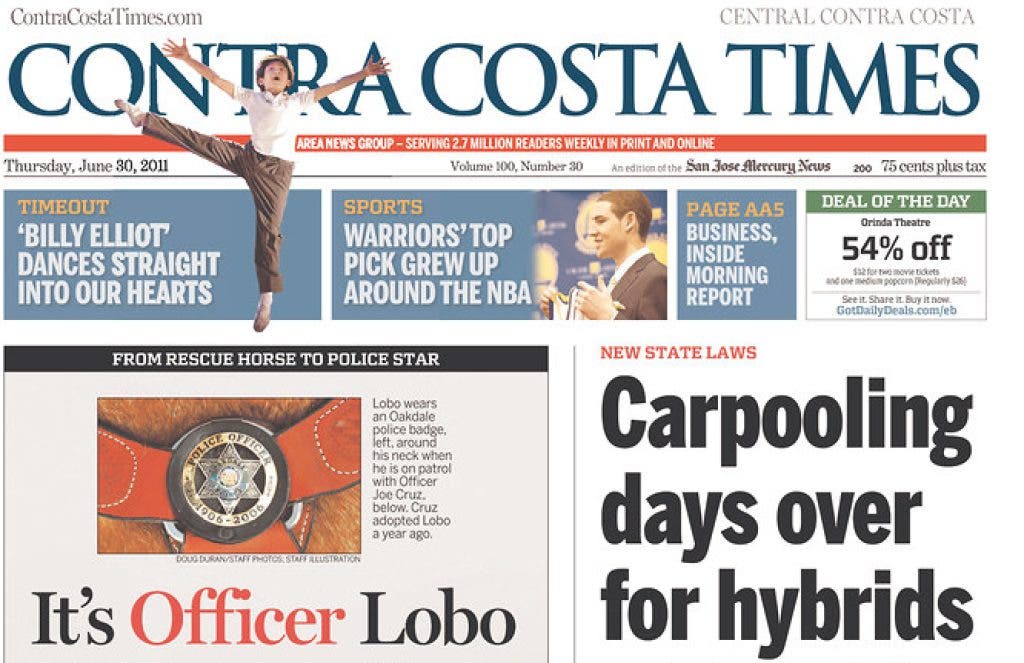
The Bay Area News Group (BANG) on Tuesday announced a "rebranding" of most of its East Bay newspapers, including "a streamlining of its print operations."
Eleven East Bay newspapers will be consolidated into two: the Contra Costa Times and the East Bay Tribune (formerly the Oakland Tribune).
BANG announced its intent to close the Contra Costa Times building on Shadelands Drive "to move to a smaller one in Contra Costa County," the San Jose Mercury News reported. (The Mercury News is the flagship of BANG). BANG would like to remain in Walnut Creek, said Nina Lesowitz, a spokeswoman for BANG from JStokes, an advertising agency in Walnut Creek.
The company will consolidate production into three existing plants in Concord, Hayward and San Jose. Mac Tully, the San Jose-based president of BANG, said that production efficiencies at those plants "will enable BANG to utilize a smaller facility than the one currently operating in Walnut Creek."
Layoffs
The streamlining will involve layoffs from the company's East Bay papers.
Lesowitz said 120 positions will be eliminated out of about 1,500 in the company by Nov. 2, the scheduled date for most of the changes to take effect.
About 40 of those are expected to be newsroom positions, one source told Patch. Lesowitz said it's difficult to be that precise. "Management is going to evaluate who will be leaving and who will be switching over to a different position," she said.
Tully said existing newspaper titles will continue to be published after the changes take effect on Nov. 2, but under two consolidated mastheads: the Contra Costa Times and the East Bay Tribune (including the current Oakland Tribune), according to the Mercury News article. That consolidation is due to take place Nov. 2.
The Contra Costa Times, Valley Times, San Ramon Valley Times, Tri-Valley Herald, San Joaquin Herald, and East County Times will now be branded under the Times masthead, while the Oakland Tribune, Alameda Times-Star, Daily Review, Argus and West County Times will be rebranded as the East Bay Tribune.
This shakeup comes almost two months after l in which BANG put San Jose-based editors in charge of the operations of the Contra Costa Times and the Tribune, including the ouster of two longtime Walnut Creek BANG editorial leaders, Kevin Keane and Pete Wevurski.
It's just the latest in three years of restructuring and layoffs the company has gone through in an attempt to cope with losses in advertising sparked by the recession, lagging circulation and a move in ad dollars to the Internet.
(Click this link to read about a cut of 17 employees at the company in 2009.)
Rebranding
The current rebranding includes enhancements plus an emphasis on multimedia content delivery that will continue to enlighten and entertain readers while providing new opportunities for advertisers to engage readers, the Mercury News said.
The consolidation will include the launching of two new weekly newspapers under the BANG flag — the Valley Journal, serving Alamo, Danville and San Ramon; and the Times-Herald, serving Dublin, Pleasanton, Livermore and Sunol, according to a Frequently Asked Questions page on the Mercury-News website.
"We will continue to be the largest newsgathering and newspaper publisher in the Bay Area," said Tully. "We remain committed to embracing emerging digital technologies to buttress our existing products and services."
"I hope the paper stays around for a while," wrote Oliver jb, a commenter on Patch's Facebook page. "The Internet just doesn't have the right crinkle sound like a real paper, and I need that with my morning coffee!"
And what of AOL shares? They've gone from about 27 a share late last November to under 15 a share today... sounds like confidence to me.
But I don't think one can simply project forward from the current situation. Speaking generally, it seems like common sense that building up a huge company is going to require an initial investment for which it will take time to see returns. It seems crazy (to me) to think that a year-old company would/should already be profitable. I hope we are given that time, but, at the end of the day, I don't feel a need to sit around wondering about it. I'm not really clear on what the obsession is about this aspect of the company. As for those citing Business Insider, which tends to post single-source stories by anonymous former (disgruntled?) employees, it's surprising to me that people *would* put weight into reporting that weak. I don't know those people, but I can say none of that reporting has resonated with me. I'm sorry but I don't get it.
As JD mentioned, if a comment is an outright attack, contains profanity, etc., it will be removed. Commenters can delete their own comments. And other users can "flag" comments, which eventually will remove them. Claims of censorship are nothing but outright paranoia.
I do object to anonymous bloggers, but don't remove their comments.
The editors and paid staff of Patch are the released former employees of newspapers. Of course they want to defend Patch, otherwise they will end up like their Blogging Partners, unpaid and on the dole or just about to be that. Do not look for great journalism, it is just a job. Do not rock the boat, feed the kids, go out to eat, put gas in the car and be glad that you are not part of the 12+% who are out of work. There is no room in Patchville for Mighty Casey. He has struck out. Be happy that maybe Patch will be successful as the electronic successor to the Penny Dreadful or cat box and bird cage liner. Crusading journalists? Not in Patch.
As to your comment about Editor, no the editor edited their reporters and the focus of the department or desk that the editor ran. The editor did not edit John Q. The editor chose the few letters that they would print. Soon the Supreme Court will decide whether the internet and digital data is interstate commerce and therefore under federal jurisdiction. Until that time the internet and posting is simply the wild west. Sheriff Patch can deal with his version of miscreants any way he wants, until the town fathers ask him to clean up his act.
Coming up in aerospace in the 80's we were put through the Japanese Total Quality Management (TQM) followed by Continuous Process Improvement (CPI) trainings. There are times when I believe every job sector should have been made to do likewise. In these disciplines we were taught to redefine the term "customer" and identify our internal as well as our external customers. Earlier Ralph, the new editor for WC I think, opined that technology played a large role in contracting newsrooms. As a consumer of news I believe the industry, as a whole, has lost sight of who their customers are. I may be wrong but it feels like those who make resource decisions saw the bright new shiny toy of cable news, with its reach, and thought to recreate that in print. The result is sensational headlines, loss of the man on the street identity and people have tuned out. I don't believe all is lost in print journalism but I do believe getting back to basics is essential. That seemed to be the initial promise of Patch.
http://ir.aol.com/phoenix.zhtml?c=147895&p=irol-calendar Earnings call http://ir.aol.com/phoenix.zhtml?c=147895&p=irol-newsArticle&ID=1594530&highlight= http://corp.aol.com/ http://www.aol.com/
http://phx.corporate-ir.net/External.File?item=UGFyZW50SUQ9MTAzMjkyfENoaWxkSUQ9LTF8VHlwZT0z&t=1 Tim Armstrong - AOL Inc. – CEO In local we advanced Patch in the 44 new towns, and have amassed almost 10 million views as I mentioned, the revenue here is small, but it is growing very quickly. In Patch, we continue to improve the services we are bringing to towns, and I think we are seeing tremendous traffic growth from consumers in Patch, we are now turning our focus to the local businesses, and how we actually continue to innovate on the business side and revenue side on Patch. Revenue is growing quickly on Patch, but we can do a much better job of servicing the local businesses. On August 1st we launched our new product for Patch, which is going to allow advertisers to help them drive traffic to their stores, drive leads to service business, and sell products online. Patch has a very concise list of work to do and they are doing it. And Patch profitability, Patch has grown very nicely from the consumer side. We are in the right markets in the right sized towns, and now we really want to turn our attention to turning that traffic into revenue. So just highlights for me growing traffic, growing scale in the ad offerings, and Patch profitability. I want to point out that we remain vigilant on expenses.
Ross Sandler - RBC Capital Markets - Analyst Thanks, guys. Just two questions first. Tim, can you talk a little bit about the current environment you are seeing in domestic display in 3Q, were July, or these first few days August any different than the ending trajectory in June? And then the second question for Artie, so this new updated range of $340 million to $370 million for 2011, is obviously below Consensus expectation. I am just wondering what the disconnect is? Is it because you are expecting lower revenue from higher margin areas, or are the Patch losses accelerating? And then given the access and search secular declines, is there any comfort that that this might be the trough run rate by which we can build on next year, or are you expecting next year to be below this range? P. 10 Artie Minson - AOL Inc. - CFO Hey, it is Artie. Let me answer a couple of your specific questions there.
terms of the takedown of the OIBDA range, you asked what was driving it, and it is really a reduction from what had been our prior expectations on domestic display. And as I said, and to a lesser extent search. Specifically, it is not due to any acceleration of the Patch expenses, which was a question you had asked, that those to be clear, are not accelerating. On 2012, we are not going to give any forward look on 2012 as of yet. So I think I will just leave it at that. Tom White - Macquarie Research - Analyst Thanks for taking my question. A question on Patch, it sounds like sort of the cost side of the equation is kind of in line. What milestones will you guys be looking at, in order to judge that Patch is on a successful path to profitability such as traffic, ad coverage. And then just secondly, should we expect any benefit to your ad business, specifically HuffPost from the political calendar next year, and if so, when will that start showing up in the numbers? Tim Armstrong - AOL Inc. - CEO Yes. I think just to quickly hit on it, is we measure every single individual Patch individually, and I think the metrics that we look at there are traffic. So for instance even the first three Patches that we have started basically had double-digit growth during Q2.
you have to remember we started this had year with very few customers and very little revenue. By the time we exit this year, we will have a meaningful amount of customers, and a meaningful run rate on Patch. I think Patch will look like a very smart investment on the AOL side. And then I would just say second, there are two areas where there is upside in the advertising for Patch. One, you mentioned political, every candidate I have talked to, I talked to Corey Booker, I have talked to Governor Christie, we get notes all the time from Senators and Governors about Patch. I think Patch is one of the most watched things in the political landscape outside of DC, for how communities are doing, so I would expect us to have political upside there. We have a very robust plan actually for how we use all of our properties on the elections front, and gain market share in advertising from that. The second area is I would say we have companies like Hewlett-Packard running on Patch right now with the Project Devil ad, and there is a very significant interest from national advertisers, especially the big box retailers and their OEM partners or channel partners for Patch. Most of the Patches are within a 10-mile radius of most of where all of the big box retailers are. So we continue to see interest there. I would say the product we just launched on Patch for August 1st, we just launched is a meaningful improvement to what we are bringing to the marketplace.
By Maxwell Wessel Posted on Harvard Business Review: August 19, 2011 10:30 AM Disclosure: The author is a shareholder in AOL. Here's the same post from Harvard Business Review's site w/their comment stream: http://blogs.hbr.org/cs/2011/08/why_aol_should_double-down_on.html
One commenter was right when he wrote, "It´s easier for companies like Garnett or McClatchy to learn to capitalize on their local websites than to AOL to compete with them for local news and revenue."
Return to investigative reporting role Matt
Yep. Seems like perfectly reasonable arguments to me. Next.....
We're going to redirect the comments on this article to our East Bay Patch Facebook page (http://www.facebook.com/EastBayPatch) mainly for technical reasons: We're getting so much participation on this story that the comments have dominated the "What Do You Have To Say" box on our individual Patch home pages. Generally, we don't have a concern about that. However, when the story is regional and the discussion is this robust, we have a comment stream that takes us away from our mission to be locally focused. Maybe we'll find some technical solutions so that in the future we can continue to offer articles that are regional in nature without having this issue crop up. In the meantime, if you care to continue to talk about East Bay journalism, please join us here: http://www.facebook.com/EastBayPatch.